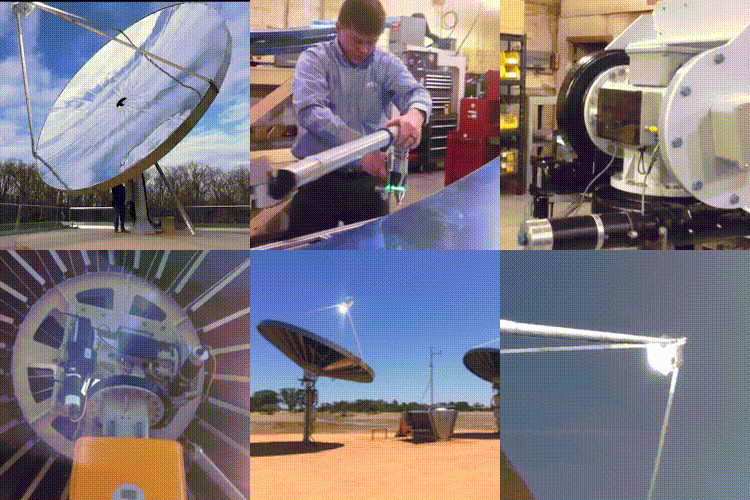
Many people and companies want to benefit from solar hot water because it is free and it is environmentally responsible. Many people are familiar with solar hot water systems like flat panels. However, the newest technology that is being approved for certification is the SolarBeam Concentrator, a parabolic concentrator that tracks the sun and produces up to 12kW of solar hot water.
Shown below is a calculator that shows how much energy 1 SolarBeam can produce of solar hot water.
The SolarBeam can heat 600 liters of cold water from 12 celcuis to 85 celcuis in 4.5 hours (based at a solar radiation of 1000 w/m2)
| CALCULATOR | |
| Type | STATIC HOT WATER (METRIC) |
| Amount of Hot water per DAY (Liters) | 600 |
| Direct kWh/day/m2 (average) | 4.5 |
| Initial water temperature (celcius) | 12 |
| Desired water temperature (celcius) | 85 |
| Average Dish kWh | 47.9 |
| Kwh Required | 50.9 |
| Number of SolarBeams | 1 |
This powerful solar hot water system is available to residential and commercial customers.It can be sold to any facility that uses hot water. Shown below are some applications:
- Wineries
- Beverage Companies
- Hotels
- Apartments
- Schools/Universities
- Industry
- Greenhouses
Solar Hot Water Incentives for New York
Solar thermal rebate program – National Grid:
-Through this program, National Grid offers funding for residential customers who install solar thermal technologies.
-This rebate pays 15% of the total of a residential system.
– Maximum incentive amount is $1,500.
-In order for participants to receive a rebate, they must share their water heating usage data for 12 consecutive months.
Residential renewable energy tax credit:
-This personal tax credit allows the taxpayer to claim a credit of 30% of expenditures including labor costs and installation of qualified residential solar-electric systems, solar water heating systems or fuel cells. Small wind-energy systems and geothermal heat pumps can also be accredited for.
-Solar-electric systems and solar water heaters have a maximum incentive of $2,000 if placed in service before 2009. There is no maximum incentive for systems placed after 2008.
-The excess amount of the federal tax credit may be carried forward to the next taxable year if it exceeds tax liability.
-This can be carried forward until 2016, but after that, it is unknown if the unused credit will be able to be forwarded.
Residential energy conservation subsidy exclusion:
-This is a personal exemption of 100% of energy conservation subsidies provided by public utilities.
-The value of a purchase or installation of any energy conservation measure by a customer such as solar water heat, solar space heat or photovoltaics will not be included in the customer’s gross income.
-Customers of an electric utility company, who participate in the utility’s energy conservation program, may receive a rate reduction of electricity furnished or a nonrefundable credit against the purchase price of the electricity on each monthly electric bill.
Energy-efficient mortgages:
-This is a federal loan program where homeowners can use EEM (energy-efficient mortgages) to finance renewable energy technologies in a home.
Recent Comments