
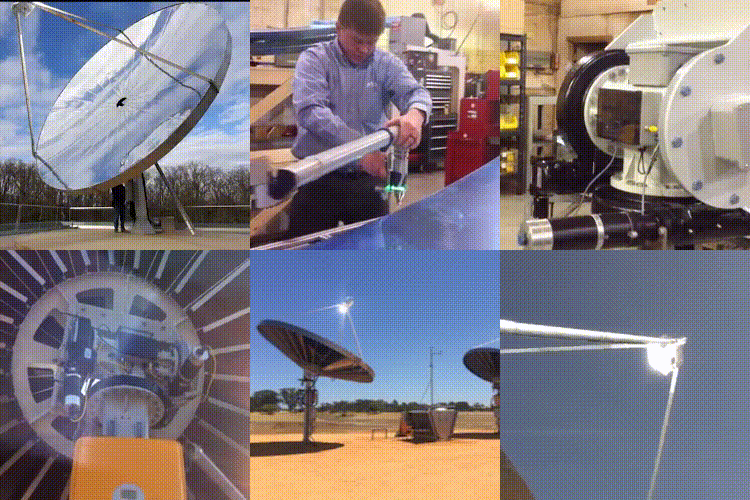
The design of the SolarBeam is an engineering masterpiece. As shown below in the research article, the manufacturing of paraboloidal dish-shaped reflectors require relatively sophisticated fabrication techniques of metal spinning, plastic molding or ‘die pressing’.
For those who are not familiar with a parabolic concentrator, shown below is an excerpt:
Paraboloidal concentrators have the ability to raise various absorbers and working fluids to high temperatures. The maximum concentration factor and temperature attainable in practice depends on the aperture size (area intercepting solar radiation), reflectivity, and accuracy of the surface contour, and the degree to which the concentrator approximate a true paraboloidal geometry. Paraboloidal concentrators have been used for various applications, from cooking[1] and driving hot-air operated pumps for lifting water[2], to providing power for space-craft[3] through a mercury-vapor driven electric generator. In recent times the merits of various types of non-imaging compound concentrators[4] which collect not only the direct beams of radiation but also part of the scattered component, has been described in literature.
It is generally believed that paraboloidal dish-shaped reflectors require relatively sophisticated fabrication techniques of metal spinning, plastic molding or ‘die pressing'[5]. A practical and elegant technique of fabricating
Paraboloidal concentrators have the ability to raise various absorbers and working fluids to high temperatures. The maximum concentration factor and temperature attainable in practice depends on the aperture size (area intercepting solar radiation), reflectivity, and accuracy of the surface contour, and the degree to which the concentrator approximate a true paraboloidal geometry. Paraboloidal concentrators have been used for various applications, from cooking[1] and driving hot-air operated pumps for lifting water[2], to providing power for space-craft[3] through a mercury-vapor driven electric generator. In recent times the merits of various types of non-imaging compound concentrators[4] which collect not only the direct beams of radiation but also part of the scattered component, has been described in literature.
It is generally believed that paraboloidal dish-shaped reflectors require relatively sophisticated fabrication techniques of metal spinning, plastic molding or ‘die pressing'[5]. A practical and elegant technique of fabricating
A Simple Technique of Fabrication of Paraboloidal Concentrators
*Solar Energy, Volume 22, pp 463-465
M. Srinivasan, L. V. Kulkarni, and C. S. Pasupathy
Neutron Physics Division, Bhabha Atomic Research Center, Trombay, Bombay 500 085, India
Recent Comments